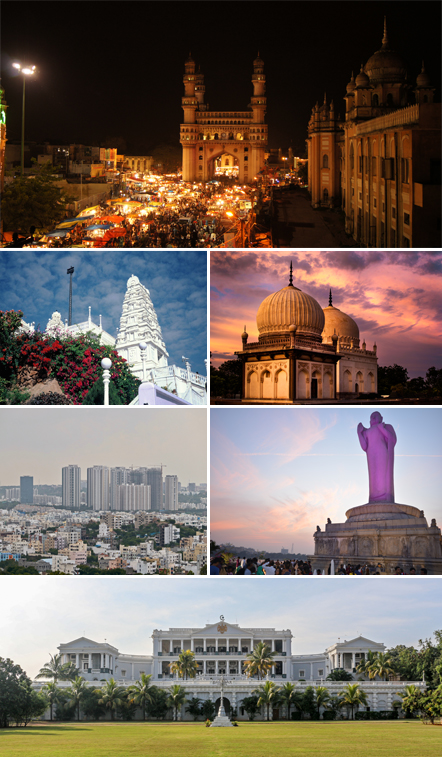
Overview
Hyderabad is the capital and largest city of the Indian state of Telangana. Located on the Deccan Plateau along the banks of the Musi River, it serves as a major centre for information technology, pharmaceuticals, biotechnology, and aerospace industries in southern India. The city is known for its blend of Indo-Islamic and South Indian heritage, exemplified by landmarks such as the Charminar, Golconda Fort, and the Qutb Shahi tombs.
Key Facts
| Country | India |
|---|---|
| State | Telangana |
| Region | Deccan Plateau, southern India |
| Founded | 1591 by Muhammad Quli Qutb Shah |
| River | Musi |
| Status | State capital of Telangana |
| Famous landmarks | Charminar, Golconda Fort, Qutb Shahi Tombs, Chowmahalla Palace, Falaknuma Palace |
Background
Hyderabad was founded in 1591 by Muhammad Quli Qutb Shah, the fifth ruler of the Qutb Shahi dynasty, as the new capital of the Golconda Sultanate. The Charminar was constructed at the city's centre as part of its founding plan. After the Mughal emperor Aurangzeb captured Golconda in 1687, the region came under Mughal administration. In 1724, Mir Qamar-ud-Din Khan, also known as Asaf Jah I, established the Asaf Jahi dynasty, founding what became the princely state of Hyderabad under the Nizams.
During British paramountcy, Hyderabad was the largest princely state in India by area and revenue. After Indian independence in 1947, the state initially resisted accession; it was integrated into the Indian Union in September 1948 following Operation Polo. With the reorganisation of states on linguistic lines in 1956, Hyderabad became the capital of Andhra Pradesh. On 2 June 2014, following the bifurcation of Andhra Pradesh, Hyderabad became the capital of the newly formed state of Telangana, while also serving as the de jure joint capital of Andhra Pradesh for a transitional period.
Geography and Climate
Hyderabad lies on the Deccan Plateau at an average elevation of around 540 metres above sea level. The city's terrain is characterised by rocky outcrops and several artificial lakes, the most prominent being Hussain Sagar, built in 1563, which separates Hyderabad from its twin city Secunderabad. Other notable water bodies include Osman Sagar and Himayat Sagar. The climate is tropical wet and dry, with hot summers, a monsoon season from June to September, and mild winters.
Economy
Hyderabad's economy is anchored by information technology and pharmaceuticals. The HITEC City (Hyderabad Information Technology and Engineering Consultancy City) area, developed from the late 1990s, hosts offices of major Indian and multinational technology firms. The Genome Valley cluster supports biotechnology and life sciences research. The city is also a major centre for the pharmaceutical industry, hosting companies such as Dr. Reddy's Laboratories and Bharat Biotech. Other significant sectors include defence and aerospace, with establishments such as the Defence Research and Development Laboratory and Bharat Dynamics Limited based in or near the city.
Culture and Heritage
Hyderabad is known for its distinct cuisine, with Hyderabadi biryani, haleem, and a range of dum-cooked dishes recognised as part of its culinary heritage. The Deccani dialect of Urdu is widely spoken alongside Telugu, the official state language. The city's craft traditions include Bidriware metalwork and pearl trading, the latter giving Hyderabad the nickname "City of Pearls." Annual events include the Numaish industrial exhibition and observances such as Bonalu and Bathukamma.
Education and Research
Hyderabad hosts several institutions of higher learning and research, including the University of Hyderabad, Osmania University, the Indian Institute of Technology Hyderabad, the International Institute of Information Technology Hyderabad, the National Institute of Pharmaceutical Education and Research, the Centre for Cellular and Molecular Biology, and the Indian School of Business.
Transport
The Rajiv Gandhi International Airport at Shamshabad serves as the city's principal airport. Hyderabad is connected by the South Central Railway zone, with major stations at Secunderabad, Hyderabad (Nampally), and Kacheguda. The Hyderabad Metro, an elevated rapid transit system, began commercial operations in 2017. The Outer Ring Road encircles the metropolitan area, linking it to national highways.
Comments
0 comments
No comments yet.